Himeji Castle is the largest and most visited castle in Japan. It's widely considered Japan's most spectacular castle. Unlike many other Japanese castles, Himeji Castle was never destroyed in wars, earthquakes, fires, or other disasters - and is currently still in its original form. It was built in the early 17th century, and represents the highest achievement in Japanese castle architecture. The hilltop castle complex consists of over 83 buildings and advanced defensive systems dating back to the feudal period.
Because of its elegant appearance totally covered with white plaster, the castle has been compared to a white bird taking flight. It's famous knickname is the White Heron Castle. In 1993 it was registered as one of the first World Heritage Sites in the country.
We were super excited to take a day trip to view this spectacular castle. So I don't even need to tell you how disappointed we were when we arrived and saw this....
Yep, that's right, it was completely covered. Had we done our research, we would have known that this castle is under a FIVE YEAR restoration project. So not only could we not see the outside, but the interior of the castle was also completely closed off. Major bummer.
So we walked around the exterior of the castle and to the West Bailey building that is still open to the public. The West Bailey was the former home of Princes Sen and her husband Tadatoki Honda, the son of Lord Tadamasa Honda.
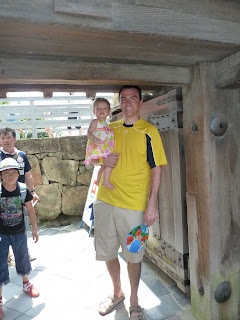 |
| Watch your head! |
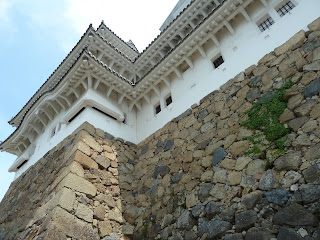 |
| Looking up! |
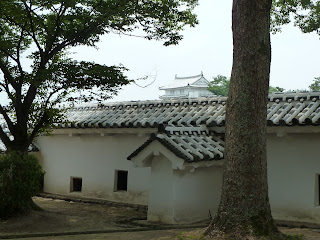 |
| Walking around the exterior. |
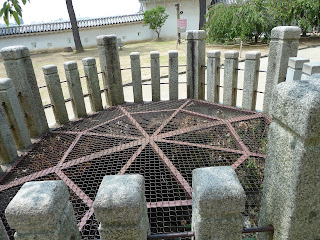 |
| This is the well for the setting of the famous ghost story, called "Banshu Sara-Yashiki." A long time ago, a servant named Okiku, who served the lord of the castle, was falsely accused of stealing a valuable dish. She was tortured to death on the charge of the missing dish and then her body was thrown into this well. The story goes that you can still here the poor girl screaming from the well. |
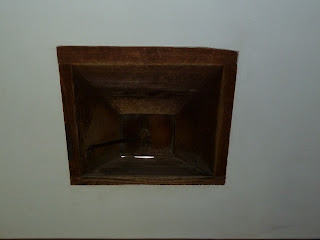 |
| "Stone Throwing Hole" - if enemies tried to scale the walls, defenders
could drop stones or boiling water, or throw spears or shoot guns
through this hole. Similar holes can be found throughout the castle
grounds. The stone throwing holes of Himeji Castle are said to be the
finest in the history of Japanese castle architecture, combining a
decorative appearance with a deadly function. |
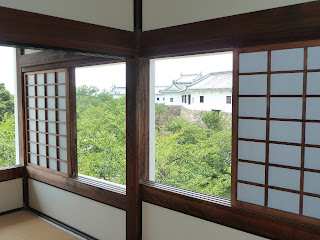 |
| Windows of Princess Sen's room. |
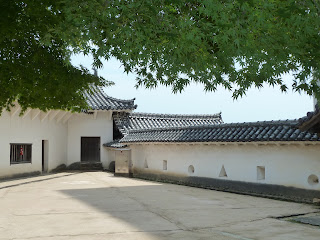 |
| I loved the triangle, square, circle, and rectangle "windows." |
After walking around the exterior, we headed over to nearby Koko-en garden. It's the former site where a mansion of the Himeji lord and his men's samuri houses existed. Now it's a large Japanese garden with a teahouse and restaurant.
We ate a traditional meal at the restaurant here, the local specialty: conger eel.
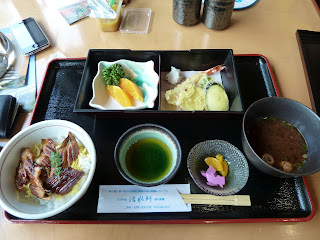 |
| Japanese traditional meal: conger eel on rice, tempura, miso soup, and pickled veggies. It was fantastic! |
 |
| Walking on the bridge through the garden. |
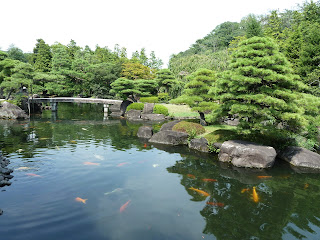 |
| View of part of the garden. |
The garden was stunning, but it was really too hot out to enjoy it. So we did a brief loop and then headed to the ice cream shop... or as the Japanese say, ソフトクリーム ("softo creamu")
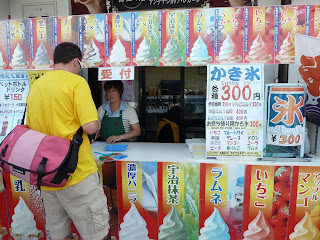 |
| Joe of course got chocolate, I had mango strawberry swirl. Both were fantastic. Perfect way to end our day trip to Himeji Castle. |
Despite being thoroughly disappointed that we couldn't see or enter the castle, and the fact that it was a bazillion degrees out, we still managed to have a good time. It was a nice day trip, we saw and learned a lot, and look forward to visiting again in 2015 when the restoration is complete. :)


bummer.... guess you have a reason to go back =)
ReplyDelete